
If you’re thinking about breeding your Chihuahua, congratulations — you’re about to take on one of the most rewarding (and most misunderstood) jobs in the dog world. But here’s the truth: knowing how to ethically breed Chihuahuas isn’t optional. It’s the whole job. This guide walks you through everything from picking a healthy pair to raising puppies who go on to live long, happy lives.
Why Ethical Breeding Matters More Than Ever
Chihuahuas are tiny, but the health risks tied to careless breeding are anything but small. Because of their compact size, Chihuahuas are prone to specific structural and genetic issues — luxating patellas, heart murmurs, hydrocephalus, dental crowding, and hypoglycemia, to name a few. When breeders skip health testing or breed for looks alone, they pass these problems straight down the line.
Learning how to breed Chihuahuas responsibly means treating every litter as a long-term commitment, not a one-time transaction. It means your goal is healthier, better-tempered dogs — not just more puppies.
Chihuahua Breeding Guide for New Owners: Where to Start
If this is your first time considering breeding, slow down before you do anything else. A Chihuahua breeding guide for new owners should always start with education, not with putting two dogs in a room together.
- Learn the breed standard. Understand what a structurally sound Chihuahua looks like — proper apple-shaped head, correct bite, straight legs, no signs of molera complications beyond the normal soft spot.
- Talk to a reputable breeder or breed club. Organizations like the Chihuahua Club of America publish health testing protocols — use them as your baseline.
- Find a vet who specializes in toy breeds. Chihuahuas require different anesthesia dosing, whelping considerations, and neonatal care than larger dogs.
- Understand the financial reality. Emergency C-sections, which are common in toy breeds, can run $1,500–$4,000. If you can’t budget for that, you’re not ready to breed.
- Have a plan for every puppy. Never breed without a waiting list of vetted, screened homes — or a firm plan to keep any puppy that doesn’t find one.
How to Ensure Chihuahua Health During Breeding
This is the section to bookmark. How to ensure Chihuahua health during breeding comes down to testing, timing, and monitoring — before, during, and after the pregnancy.
1. Pre-Breeding Health Screening
- Cardiac exam — Chihuahuas are prone to mitral valve disease; a vet cardiologist should clear both parents.
- Patella evaluation — luxating patella (slipping kneecap) is one of the most common toy-breed issues and is partly hereditary.
- Eye exam (CERF/OFA) — screens for progressive retinal atrophy and other inherited eye conditions.
- Dental and jaw assessment — check for correct bite alignment before breeding for it further.
- Brucellosis test — a bacterial infection that causes infertility and pregnancy loss; test both dogs before every breeding.
- General bloodwork — confirms the dam is in strong physical condition to carry a litter.
2. Age and Size Requirements
This is non-negotiable: never breed a female Chihuahua before her second heat cycle or age two, whichever comes later, and never after age five or six (talk to your vet about her specific case). A female Chihuahua under 5 lbs is at significantly higher risk for pregnancy and whelping complications — many responsible breeders set a 5–6 lb minimum weight threshold for the dam.
3. During Pregnancy
- Switch to a high-quality puppy or performance food once pregnancy is confirmed (around day 21–28) to support the extra caloric demand.
- Schedule an ultrasound around day 28–35 to confirm pregnancy and estimate litter size — this matters a lot for a breed prone to singleton (oversized single-puppy) pregnancies.
- Take an X-ray around day 55 to get an accurate puppy count, which helps you know when whelping is complete and whether a C-section may be needed.
- Keep stress low. Chihuahuas are sensitive dogs, and cortisol spikes can affect pregnancy outcomes.

Healthy Chihuahua Breeding Pair Tips
Picking the right pair is half the battle. These healthy Chihuahua breeding pair tips will help you evaluate compatibility beyond just “do they look cute together.”
| Factor | What to Look For | Why It Matters |
|---|---|---|
| Size match | Sire should not be dramatically larger than the dam | Reduces risk of oversized puppies and difficult whelping |
| Genetic diversity | Avoid breeding close relatives (no father-daughter, brother-sister) | Prevents concentrating inherited health defects |
| Temperament | Both parents should be confident, non-reactive, and well-socialized | Temperament is heritable — anxious or aggressive dogs often produce anxious puppies |
| Health clearances | Current cardiac, patella, eye, and brucellosis clearances for both dogs | Directly reduces odds of passing on hereditary conditions |
| Coat & color | Never pair two merle Chihuahuas | Double-merle breeding causes blindness, deafness, and other severe defects |
| Age & condition | Dam 2–5 years old, sire proven and healthy | Peak fertility and lowest complication risk window |
How to Ethically Raise Chihuahua Puppies
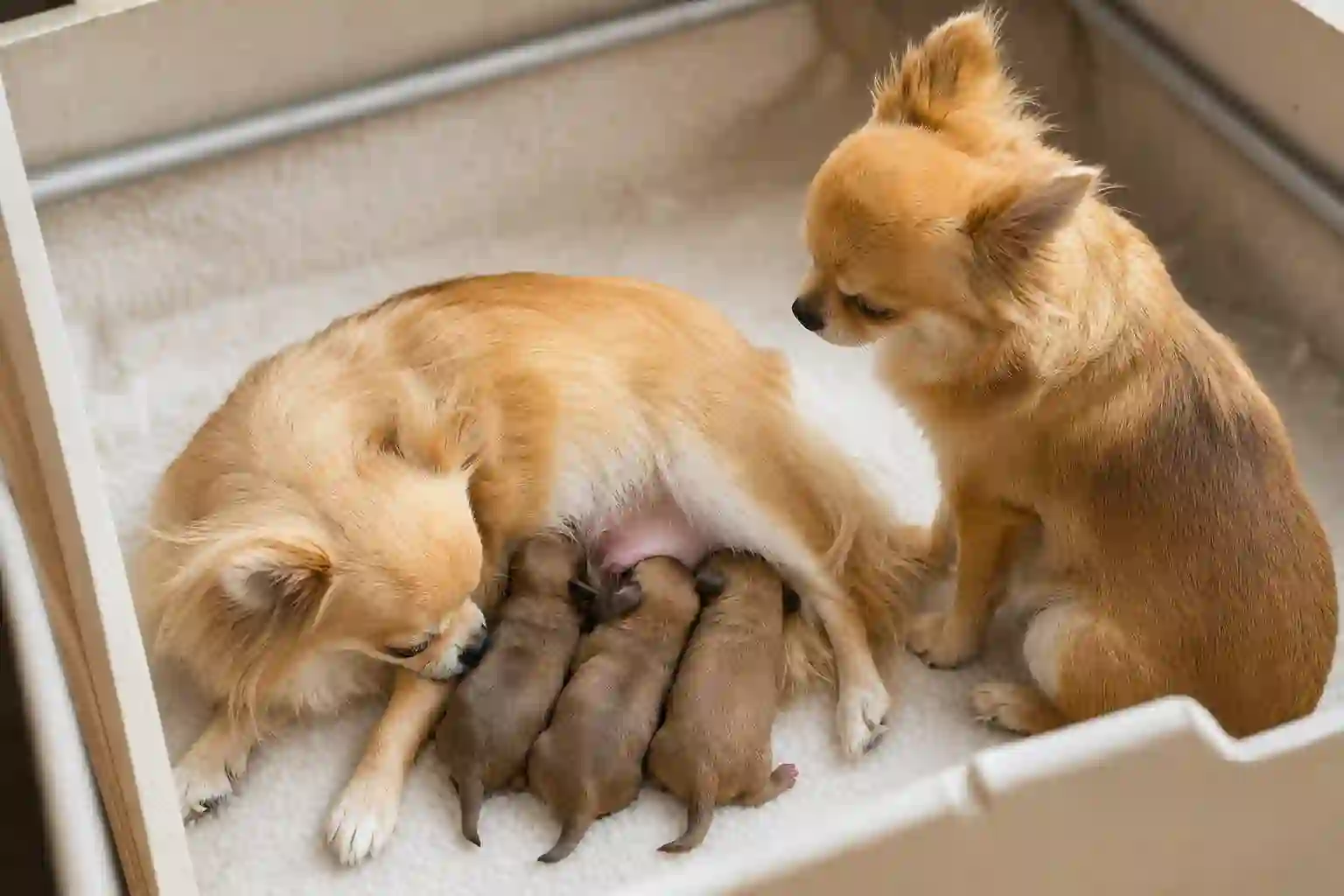
Once the puppies arrive, the real work of how to ethically raise Chihuahua puppies begins. This stage shapes their health and temperament for life.
Newborn to 2 Weeks
- Keep the whelping box at 85–90°F for the first week — Chihuahua puppies cannot regulate body temperature on their own.
- Weigh each puppy daily; steady weight gain is the #1 sign of good health at this stage.
- Watch for signs of hypoglycemia (weakness, tremors) — a serious risk in toy breed neonates.
2 to 8 Weeks
- Begin early neurological stimulation and gentle handling starting around day 3, then expand socialization as eyes and ears open (10–14 days).
- Start weaning onto soft, high-quality puppy food around 3.5–4 weeks.
- Deworm on schedule (typically every 2 weeks starting at 2 weeks old) and begin the vaccine series around 6 weeks under vet guidance.
- Expose puppies to varied sounds, surfaces, gentle handling, and (once age-appropriate) new people — this window shapes lifelong confidence.
Placing Puppies Responsibly
- Never release a Chihuahua puppy before 8 weeks of age — many states legally require this minimum, and it matters developmentally.
- Screen every buyer: ask about their home setup, other pets, experience with toy breeds, and expectations.
- Provide a health guarantee, vet records, a care/feeding guide, and your contact info for life — ethical breeders take their dogs back if a home doesn’t work out, no questions asked.
- Avoid selling through pet stores or to unscreened brokers — you lose all ability to vet the home.

Quick-Reference Checklist: Ethical Chihuahua Breeding
- ✅ Both parents health-tested (heart, patella, eyes, brucellosis)
- ✅ Dam is between 2–5 years old and at least 5–6 lbs
- ✅ No shared close relatives between sire and dam
- ✅ Neither parent carries merle if the other does
- ✅ Emergency vet care budgeted and accessible
- ✅ Waiting list of screened, approved homes in place
- ✅ Whelping supplies and heat source ready before due date
- ✅ Puppies stay with dam and littermates until at least 8 weeks
- ✅ Lifetime take-back policy offered to every buyer
Common Chihuahua Breeding Problems & Solutions
| Problem | Solution |
|---|---|
| Difficulty conceiving | Confirm ovulation timing with progesterone testing rather than guessing by calendar days |
| Singleton pregnancy (one oversized puppy) | Monitor closely via ultrasound/X-ray; plan for a scheduled C-section |
| Dam won’t nurse or produces low milk | Consult your vet immediately; supplement with a vet-approved puppy milk replacer |
| Puppy failing to gain weight | Tube or bottle feed under vet guidance; rule out infection or birth defects |
| Signs of labor complications | Go to the emergency vet immediately if more than 2–4 hours pass between puppies with visible straining |
| Buyer can’t keep the puppy later | Honor your take-back policy — never let a puppy you bred end up in a shelter |
Final Thoughts
At the end of the day, learning how to ethically breed Chihuahuas isn’t about following a checklist to get a litter — it’s about a mindset. Every decision, from picking the pair to placing the last puppy, should be filtered through one question: Is this good for the dogs? Do that consistently, and you won’t just breed healthy Chihuahuas — you’ll be part of the reason this breed thrives for generations to come.
Want more breed-specific care guides, health charts, and responsible breeding resources? Explore our full library of handbooks at ImAChihuahuaFan.com and shop breed-lover merch at MyPawClub.com. And, as always, share your insights and experiences in the comments section below.